C103 - The Semiotics of Advertising
Week 12, Asynchronous Bundle 11
Written assignment due Friday 11/14 at 11:59 pm
Introduction
- Goal: Extend our exploration of rhetorical tropes in advertising to synecdoche and irony
- Textbook connection: synecdoche 206-207, irony 207-209
Asynchronous material
Q1-2:
- Here are two video ads that play in various ways with the notion of synecdoche:
- Q1-2. For each ad, state what the synecdoche is and how it relates to the message of the ad. Identify the ad which teases the viewer with a synecdoche but then takes it away, and explain why that is a sensible interpretation of the ad.
Q3:
- There is almost no limit to the use of irony in video ads.
- Here are a couple of fabulous anti-George W. Bush political ads from
2004 (these were non-professional spots made for a contest organized by moveon.org)
- The biggest issues in the 2004 presidential campaign (Bush 2 vs John Kerry) were security (in the post-9/11 period), Bush's invasion of Iraq, and the effects of Bush's tax cuts on the governmental deficit.
- Bear in mind the oppositional codes (oppositional ideological systems) involved: the ads were made by Democrats (liberals, progressives, anti-Bush people) and they were presumably trying especially to convince wavering Bush supporters
(Republicans, "compassionate conservatives") to turn against him. (I have pushed the textbook chapter on "codes" to the last week of the course in order to get other things covered in time for possible use in your term papers, but the idea is, the entity presenting the ad [the advertiser or a company sponsoring the ad] represents one ideological position, whereas the target audience for the ad is expected to occupy a contrasting ideological position, essentially Democrats vs Republicans here.)
- Q3. Pick one of these ads (your choice) and explain what is ironic about it and how this irony helps advance the message the ad is promoting.
Q4:
- The next "ad" is actually a parody (a fake ad), but it has terrific ironic
wit.
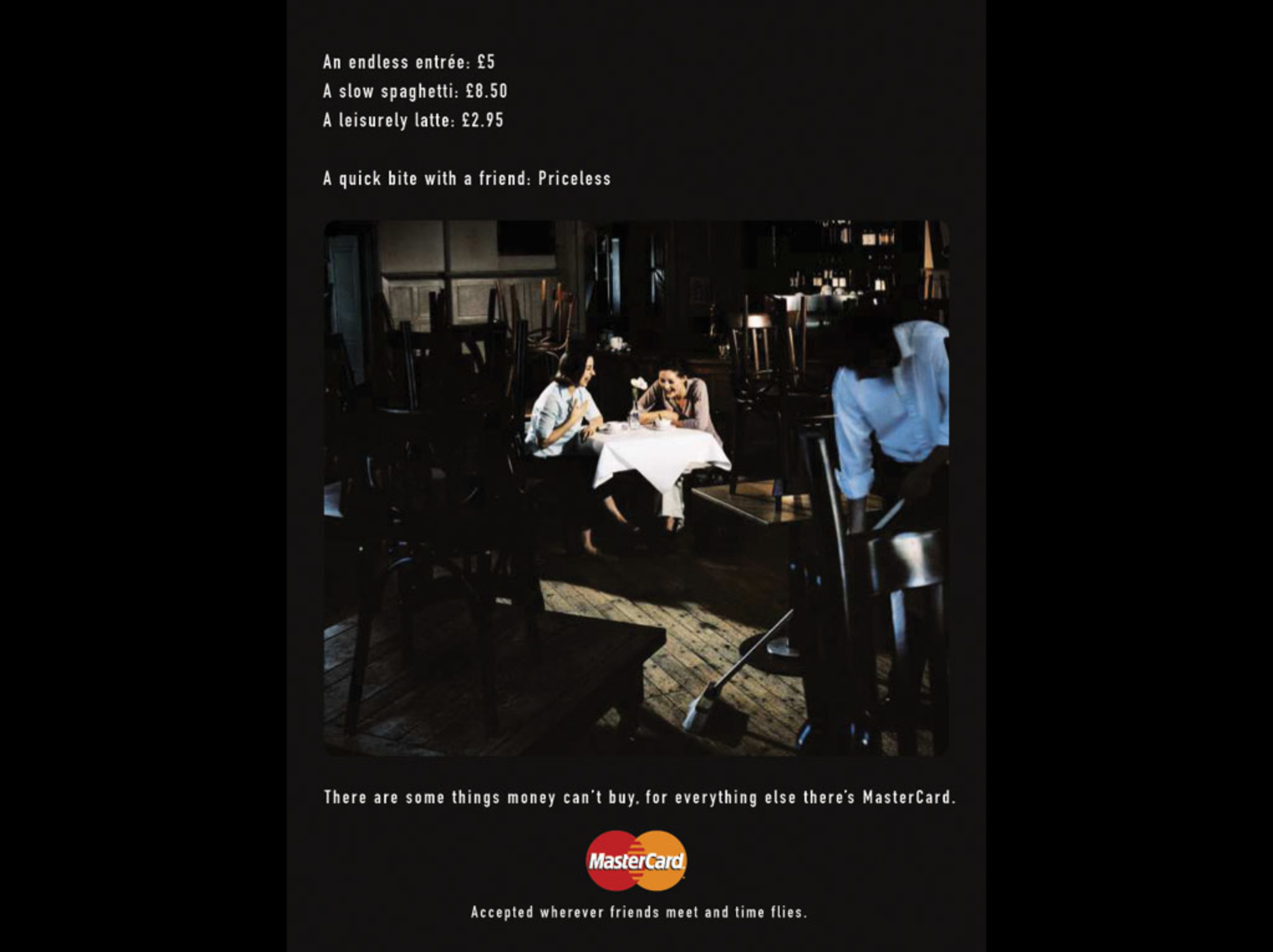
- MasterCard. It is a parody of a MasterCard ad, but it is exactly parallel to real ads that were actually made and broadcast in structure and theme.
- These particular MasterCard ads are highly susceptible to parody, and such parodies have broken out into the broader culture and can be found everywhere (an early version of "going viral"). Here's one I happened to run across recently that I liked.
- Q4. Explain the irony in this parody ad video, and address what the irony would contribute to the message if it were indeed a real ad for MasterCard.
Q5:
- Here's an old Pepsi
Super Bowl ad featuring a young Britney Spears (nothing special in and of itself, although it feels like a borderline self-parody).
- Now just listen to the applied semiotic analysis
of this ad by the comedian Lewis
Black. (A version of this routine is on one of his albums, but I like this unreleased bootleg version better.)
- I suggest you watch the ad a couple of times to pick up on a lot of the details, then listen to Lewis Black with the ad open in another tab or window, and be prepared to move the slider around in the paused video to bring up the bits he is talking about through the routine.
- As important background information, you may not recognize the man with the dog watching the ad at the end. That is Robert Dole, the Republican candidate for president who lost to Bill Clinton in his 1996 election for a second term (BEFORE the Monica Lewinsky scandal!). He had previously been Republican majority leader in the Senate. After losing the election, he basically retired and, among other things, actually did ads endorsing the erectile dysfunction medicine Viagra (a fact which is alluded to in Lewis Black's routine). If you are wondering about his right hand, he suffered a serious wound while serving in World War II, leading to paralysis of his right arm, and so he adopted the practice of always holding a pencil in that hand to prevent people from trying to shake hands with it. It became a kind of trademark for him. BTW his wife Elizabeth Dole, former US Secretary of Transportation, ran for president in the 2000 Republican primaries, without success.
- Q5. I called this comedy routine an "applied semiotic analysis" above, although Lewis Black doesn't use semiotic terminology. List as many observations as you can that the comedian makes which can be fairly regarded as semiotics, and try to restate them in semiotic terms as best you can.