C103 - The Semiotics of Advertising
Week 14 Lecture Notes
Monday 12/1/2025
Zoom link for each Monday's online lecture.
Link to watch the recording of today's lecture (available after the lecture has taken place).
For the rest of this week
- We have three bundles of asynchronous work and assignments for the week, all due as usual on Friday 12/5 at 11:59 pm.
- Bundle 16 Initial exploration of ideological codes in advertising
- Bundle 17
Explore something of the history of LGBTQ-associated advertisements and their growing acceptance over the past couple of decades
- Bundle 18 Explore political advertising, both historical and for the most recent midterm election season
- Don't forget that your term papers are due on the Thursday night of finals week, which is 12/18. Although you have already submitted proposals and presumably decided what you are going to do in the paper, the term paper info page might still be useful, especially if you get stuck while working on it. And if you need to consult with me, I generally respond quickly to emails.
- If anybody has a serious and good reason why that deadline is a problem, please email me in advance of the deadline and I'll consider requests on a case-by-case basis. Please remember that my grades are due Monday evening, and if everybody asks for an extension on the term paper, I'll be in deep deep trouble.
Codes (Chapter 4 of Chandler, 149-94)
Chandler's basic typology of codes
- Social codes
[In a broader sense all semiotic codes are 'social codes']
- verbal language (phonological, syntactical, lexical, prosodic
and paralinguistic subcodes);
- bodily codes (bodily contact, proximity, physical orientation,
appearance, facial expression, gaze, head nods, gestures and posture);
- commodity codes (fashions, clothing, cars);
- behavioural codes (protocols, rituals, role-playing, games).
- Textual codes
[Representational codes]
- scientific codes, including mathematics;
- aesthetic codes within the various expressive arts (poetry,
drama, painting, sculpture, music, etc.) - including classicism, romanticism,
realism;
- genre, rhetorical and stylistic codes: narrative (plot, character,
action, dialogue, setting, etc.), exposition, argument and so on;
- mass media codes including photographic, televisual, filmic,
radio, newspaper and magazine codes, both technical and conventional
(including format).
- Interpretative codes
[There is less agreement about these as semiotic codes]
- perceptual codes: e.g. of visual perception (note that this
code does not assume intentional communication);
- ideological codes: More broadly, these include codes for
'encoding' and 'decoding' texts - dominant (or 'hegemonic'), negotiated
or oppositional. More specifically, we may list the 'isms', such as
individualism, liberalism, feminism, racism, materialism, capitalism,
progressivism, conservatism, socialism, objectivism, consumerism and
populism; (note, however, that all codes can be seen as ideological).
- The general idea is, a code is a bundle of predispositions that you acquire by virtue of growing up and existing in our society. You learn how to think about all sorts of things, and then when you are presented with information (such as an ad), you filter that information through a code and interpret it in light of that code.
- A code is a complicated thing, and we can't itemize all the items any individual has in his code. But as fellow members of the same society, we share lots of learned bits of codes, and we learn to classify people in terms of how they agree or disagree with you in terms of their individual learned codes.
- Bundle 16 starts out with some ads that seem to presuppose a code which fits women into a particular world-view, which could have been accepted even by the majority of women if you go back far enough.
- Then the Nike ads in that bundle promote a particular attitude toward sports and its role in our lives, in effect expressing a kind of code about this aspect of our lives.
- Subsequently Chandler spends some time talking about various of these
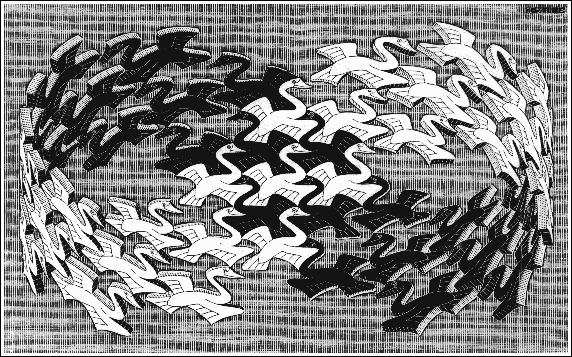
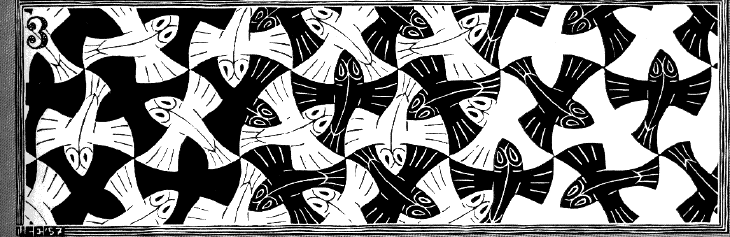
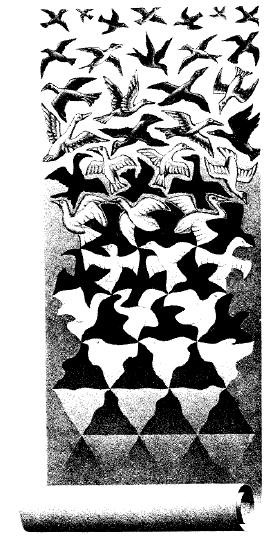
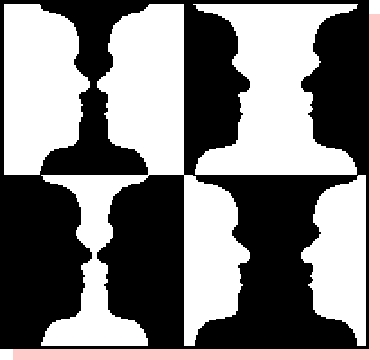
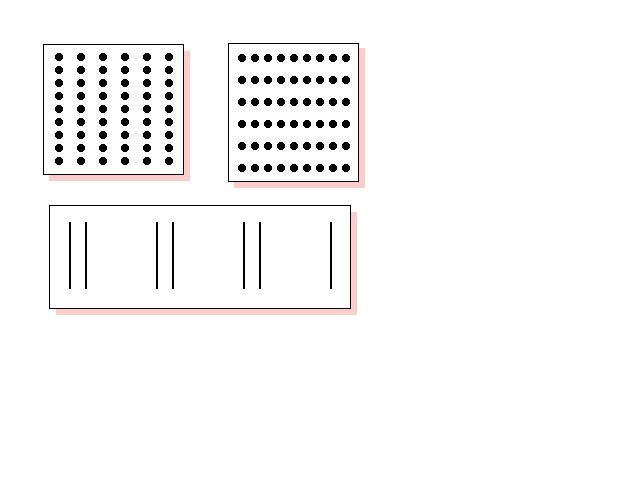
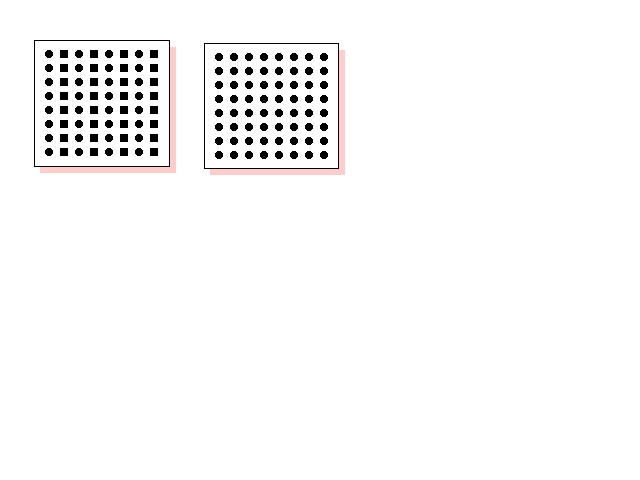
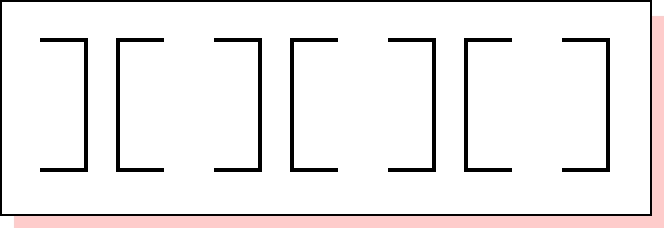
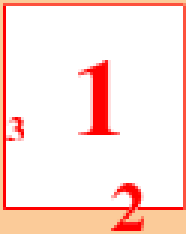
codes. Today I'll give some illustrations of how one kind of perceptual code works, namely, the distinction between figure and ground in visual image . This is something we learn as we grow up and get educated. It is by no means the only kind of perceptual code: for example, perspective in art is something that we have to learn to perceive and respond to; and there are many other things we could use as examples.
- Perceptual codes
- Figure vs. Ground
- Chandler points out that various factors contribute to our perception
of figure/ground relations
- Additional (not from Chandler):
- Figure/ground in sound!
- From Beethoven's Moonlight Sonata, triplets of ascending
notes
- From Mozart's Don Giovanni
- Bundles 16, 17, and 18 explore several areas in which codes come into play.
- In Bundle 16, we play with sexism and the ideology underlying many of Nike's ads ("sportism"?).
- In Bundle 17, we look at the history of LGBTQ-themed advertising. My thesis (not especially controversial) is that growing visibility of LGBTQ characters or personalities in mainstream advertising is effectively an index to growing social acceptance of LGBTQ people. In terms of codes, that means that the advertisers are not trying to market a controversial, oppositional code against a generally hostile audience.
- Bundle 18 explores a few political ads, mostly in historical terms. Here there is almost always an oppositional code effect: whether it is the Republicans or the Democrats, the ads are usually aimed to chip away at the opposition, to overcome a contrary ideological code (or sway a wishy-washy voter), although there can be confirmation ads which aim to encourage or retain the base of existing supporters. Many of these ads are manipulative of the viewer, or unfair in pushing some emotional buttons that have little or nothing to do with the substance of the electoral race. We will explore manipulation as opposed to persuasion as one topic net Monday in the final lecture for the course; there are a couple of bundle questions that ask you about how manipulative you perceive an ad to be, but just answer these on the basis of common sense and your natural instincts. I have deliberately not provided any advertising from the 2024 elections, as I consider they are still too close to us emotionally, and feelings are still rather intense about that election campaign.
Next week
- We will consider three small topics, and attempt to draw a few final conclusions from this course as a whole
- We will start with Paul Grice's theory of conversation dynamics, and see how it applies to the "one-way" conversation represented by advertising in the media. There are two small pdf files I'd like you to read in preparation for this material. Bundle 19 will be devoted to this material.
- Bundle 20 is devoted to "connotation, denotation, and myth", which came up in chapter 5 of the textbook, but we didn't have a chance to talk about it during week 11.
- Bundle 21 is devoted to manipulation in advertising. We have mentioned this before, but this gives me an opportunity to show some really strong, manipulative examples of advertising at its most potent.